

Gebruiker:Pjetter/klad
<Londenp> Hi. Question for someone who knows the Parser functions: Is there a way how I can find out with parser language if a certain article is in a category.
Something like if AAA is in CAT:BBB then display a certain image?
<Splarka> probably need DPL for that (depending on what you wanna do exactly)
<Londenp> In fact it is for Wikibooks
<Londenp> We have categorized the books in fases 0 to 4
<Splarka> or in JS or CSS
<Londenp> I would like to show on the front page a bookname together with a symbol for the development states
<Londenp> I couldn't find a solution with magic words and a parser
<Splarka> Londenp: well, what categorizes it? a template? or the [[category]] added directly?
<Londenp> with a template
<Splarka> so, like {{devstate|3}} ?
<Splarka> you can use the template to categorize, and generate the image
<Splarka> say you had {{devstate|3}} for example
<Splarka> [[Category:Development state {{{1|0}}}]]
<Splarka> {{#switch:{{{1|none}}}
<Londenp> OK
<Duesentrieb> Splarka: but he wants the image not on the page that is categorized, but on a pages that links to the page that is categorized
<Splarka> |0=[[Image:Devstate_0.png|40px]]
<Splarka> |1=[[Image:Devstate_1.png|40px]]
<Splarka> etc
<Splarka> really? hmmmm'
<Londenp> Duesentrieb exactly
<Splarka> DPL or javascript
<Duesentrieb> don't know if something like that exists.in any case, it would be tricky with parser cache
<Splarka> javascript could do it in a quick query to the API
<Londenp> We have Dynamicpagelist installed
<Duesentrieb> disabling it is the obvious solution, that would suck for the front page though
<Splarka> (but on the front page that would be messy)
<Splarka> DPL should be able to do it then
<Londenp> not DPL alas
<Splarka> which wikibooks?
<Londenp> nl
<Londenp> Rereading the remark from Duesentrieb it is still a little different
<Splarka> useful how it doesn't say what version of dpl it has
* Splarka grumbles
<Londenp> it is the old old one
<Londenp> http://www.mediawiki.org/wiki/Extension:DynamicPageList/old This one
<Splarka> drat, don't think you can do what you want with it then
<Londenp> That is what I thought
<Londenp> It is very useful though, but the most modern version of DPL is much better
<Londenp> but I was not allowed to let that be installed on nl.wikibooks.org
<Londenp> might try again thoug on bugzilla
<Londenp> So my idea is this {{template|bookname}} for each book
<Londenp> this will show a link to the book and display a image for the status of development of this book
<Londenp> this will automatically be updated if the status is changed
<Splarka> only way I can think of is the API, but on the mainpage that would be a lot of queries to it (and it isn't cached)
<Splarka> or a custom extension
<Londenp> The information for the status of the book is with a DPL-thing in a hidden category and the template would look in which
hidden category for the status it is and then display the according image
<Londenp> OK too bad then
<Splarka> OR.. you could create subpages for each book, that indicate the status
<Splarka> such as {{Somebook/status 1}}
<Splarka> and use #ifexist
<Splarka> but that'd be... messy
<Londenp> That is a good idea
<Londenp> Sparkla Thanks I will try that then
<Splarka> uhoh
<Splarka> don't you hate it when someone is threatening to jump off a bridge, and you say "go for it" sarcastically.. and then they do...
<Splarka> Londenp: you could also create one subpage, like [[Bookname/status]]
<Londenp> You might give me another choice :-=)
<Splarka> and have that /status contain the image that you want to transclude
<Splarka> and then always transclude [[{{{1}}}/status]] if it exists
<Splarka> that way you don't have to create and delete pages continually
<Londenp> yep
<Splarka> {{#ifexist:{{{1}}}/status|{{{{{1}}}/status}}|[[Image:Nostatus.gif]]}}
<Londenp> In fact we have something like an Infobox with the book that contains all information already
* Splarka nods
<Londenp> I just don't know how to substract that
<Splarka> heh
<Splarka> well, then...
<Splarka> what if /status only contained the number
<Splarka> 0 to 4
<Splarka> and on the infobox:
<Splarka> [[Category:Development status {{{{{FULLPAGENAME}}/status}}]]
<Splarka> and on the main page:
<Splarka> {{#ifexist:{{{1}}}/status|[[Image:Status_{{{{{1}}}/status}}.gif]]|[[Image:Nostatus.gif]]}}
<Splarka> then you just update that /status page, and both the main page and the infobox are changed
<Londenp> OK, looks good
<Londenp> but I need a little time to understand this (not being educated)
* Splarka nods
<Londenp> Sparkla thanks, I am going to study your proposals and work it out. When I have some more questions I will return.
<Splarka> thanks for the warning ^_^
test 1234567890 1234567890 1234567890 1234567890 1234567890 1234567890 1234567890 1234567890 1234567890
Citaten Papier[bewerken]
- The paper burns, but the words fly away - Ben Joseph Akiba
- What the world really needs is more love and less paper work - Pearl Bailey
- Anything on paper is obsolete - Craig Bruce
- This paper will no doubt be found interesting by those who take an interest in it - John Dalton
- When the weight of the paper equals the weight of the airplane, only then you can go flying - Donald Douglas
- When you sell a man a book you don't sell him just 12 ounces of paper and ink and glue-you sell him a whole new life - Christopher Morley
- A specification that will not fit on one page of 8.5x11 inch paper cannot be understood - Mark Ardis
- A child's life is like a piece of paper on which every person leaves a mark - Chinese Proverb
| Version | Release Date | Comments |
|---|---|---|
| 1.7 | 13/03/2007 | Ignore non-list lines when generating blacklist |
| 1.6 | 15/01/2007 | Support multiple-language translations |
| 1.5 | 16/12/2006 | Don't block all usernames when the blacklist contains blank lines Use Unicode-friendly regular expressions Don't show errors when the blacklist contains only comments (above fixes from Brion Vibber) |
| 1.4 | 19/06/2006 | Fix fatal error |
| 1.3 | 06/07/2006 | Cache blacklist in memcached or similar, if available |
| 1.2 | 25/04/2006 | Performance rewrite Allow users with the uboverride permission to pass the blacklist |
| 1.1 | 08/03/2006 | Make compatible with MediaWiki 1.5.8 Allow commenting out lines with # |
| 1.0 | 09/01/2006 | Initial version |
Boekenplank en boekenkast[bewerken]
Links:
- de:Wikibooks:Bücherregale - interessant is de opdeling vooral in werkgroepen per vakgebied en de organisatiestructuur
- en:Wikibooks:Departments - optisch niet bijzonder interessant
- fr:Wikilivres:Tous les livres - eigenlijk geen boekenplank en geen organisatie naar groepen, maar gebruikmakend van de categorie-structuur
[[{{{Vorighoofdstuk}}}|Vorig hoofdstuk]]
 |
[[{{{Vorigepagina}}}|Vorige pagina]]
 |
[[{{{Volgendepagina}}}|Volgende pagina]]
 |
[[{{{Volgend hoofdstuk}}}|Volgend hoofdstuk]]
 |
[[{{{Inhoudsopgave}}}|Inhoudsopgave]]
 |
[[{{{boek}}}|Papier]]
 |
Sjabloon:Crystalclearnavigatie
math[bewerken]
![{\displaystyle \operatorname {MSE} ({\hat {\theta }})=\operatorname {E} [({\hat {\theta }}-\theta )^{2}]}](https://wikimedia.org/api/rest_v1/media/math/render/svg/cec77dc30206b79a6e5d412c9a4a34413dcd5e52)
Normal multiplication turns this into:
![{\displaystyle \operatorname {MSE} ({\hat {\theta }})=\operatorname {E} [{\hat {\theta }}^{2}-2{\hat {\theta }}{\theta }+\theta ^{2}]}](https://wikimedia.org/api/rest_v1/media/math/render/svg/13f6f995255dbb019bbc1b807f9159813f28b6df)
The expectation of theta is exactly theta, so you can write it like that:
![{\displaystyle \operatorname {MSE} ({\hat {\theta }})=\operatorname {E} [{\hat {\theta }}^{2}]-2{\theta }\operatorname {E} [{\hat {\theta }}]+\theta ^{2}}](https://wikimedia.org/api/rest_v1/media/math/render/svg/fedce051d7faab27b27894d2a87a547c3c277119)
Add two parameters: one with a negative sign and the other with a positive sign (the sum of both is 0, but you can use that in additional calculations)
![{\displaystyle \operatorname {MSE} ({\hat {\theta }})=\operatorname {E} [{\hat {\theta }}^{2}]-\operatorname {E} [{\hat {\theta }}]^{2}+\operatorname {E} [{\hat {\theta }}]^{2}-2{\theta }\operatorname {E} [{\hat {\theta }}]+\theta ^{2}}](https://wikimedia.org/api/rest_v1/media/math/render/svg/9dc8918399029b5bb133f1c6e60bb6dda27f3b8a)
Now the second part is the usual (a-b)^2, which can be written as a^2 - 2ab + b^2. You just work the other way around.
![{\displaystyle \operatorname {MSE} ({\hat {\theta }})=\operatorname {E} [{\hat {\theta }}^{2}]-\operatorname {E} [{\hat {\theta }}]^{2}+(\operatorname {E} [{\hat {\theta }}]-\theta )^{2}}](https://wikimedia.org/api/rest_v1/media/math/render/svg/2d04e0e57040b198dd5058ef5d63c1035a44c510)
And the first part is the variance of theta-hat and the second part is the bias. This can be written as:

Now when theta-hat is unbiassed this means that the expectation of theta-hat is equal to theta and therefore the bias is zero.
And that means that the MSE of theta-hat is exactly the variance of theta-hat.
If we take for theta the mu and for theta-hat the X-bar, you will use the normal variance for a n-sample from a population (X) with mean μ and variance σ2 you will get:
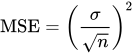
Another calculation will be as follows: We start again with:
Now we replace theta-hat with X-bar and theta with mu and you get:
![{\displaystyle \operatorname {MSE} ({\bar {X}})=\operatorname {E} [({\bar {X}}-\mu )^{2}]}](https://wikimedia.org/api/rest_v1/media/math/render/svg/82b5ca1d516c10624eca3210ffda587dbbe779ee)
We will replace X-bar in this equation with the following:

So you get:
![{\displaystyle \operatorname {MSE} ({\bar {X}})=\operatorname {E} [{\frac {1}{n}}(X_{1}+\cdots +X_{n})-\mu )^{2}]}](https://wikimedia.org/api/rest_v1/media/math/render/svg/69df484ee7fe9ab755c3aa0e7b8c0a4949f9bd8c)
This you can write differently according to:
![{\displaystyle \operatorname {MSE} ({\bar {X}})=\operatorname {E} [{\frac {X_{1}+\cdots +X_{n}}{n}}-\mu )^{2}]}](https://wikimedia.org/api/rest_v1/media/math/render/svg/24232a43d35b9cb425fbf85896f401b147036ecf)
and
![{\displaystyle \operatorname {MSE} ({\bar {X}})=\operatorname {E} [{\frac {X_{1}+\cdots +X_{n}}{n}}-{\frac {n}{n}}\mu )^{2}]}](https://wikimedia.org/api/rest_v1/media/math/render/svg/a641c74cf2e506ddfccd0e17c7323109e3515977)
which will lead to:
![{\displaystyle \operatorname {MSE} ({\bar {X}})=\operatorname {E} [{\frac {X_{1}+\cdots +X_{n}-{n}\mu )}{n}}^{2}]}](https://wikimedia.org/api/rest_v1/media/math/render/svg/8808b04edb5b7cf6878ee72867a571bab092c7a2)
We take the n in the denominator out and this becomes squarred:
![{\displaystyle \operatorname {MSE} ({\bar {X}})={\frac {1}{n^{2}}}\operatorname {E} [X_{1}+\cdots +X_{n}-{n}\mu )^{2}]}](https://wikimedia.org/api/rest_v1/media/math/render/svg/3ee970b9db5362148bb8cc540e8d760db03074bd)
which turns into:
![{\displaystyle \operatorname {MSE} ({\bar {X}})={\frac {1}{n^{2}}}\operatorname {E} [(X_{1}-\mu )+\cdots +(X_{n}-\mu ))^{2}]}](https://wikimedia.org/api/rest_v1/media/math/render/svg/17aa5188e83d59a89653a9bd997b57a5c441e00d)
Now the expectation is redistributed in the equation:
![{\displaystyle \operatorname {MSE} ({\bar {X}})={\frac {1}{n^{2}}}\operatorname {E} [(X_{1}-\mu )^{2}]+\cdots +{\frac {1}{n^{2}}}\operatorname {E} [(X_{n}-\mu )^{2}]}](https://wikimedia.org/api/rest_v1/media/math/render/svg/dcb3abcc88ca5605ed46524daf5eed74bd8cf164)
We know that the definition for sigma is
![{\displaystyle \operatorname {E} [(X_{1}-\mu )^{2}]=\sigma _{1}^{2}}](https://wikimedia.org/api/rest_v1/media/math/render/svg/59f4a572d85dfcd84ec6ecd9793bd4fbf4caa715)
so you get:

This is the variance of the unbiassed sample distribution of the mean
regression[bewerken]



The sum of squares to be minimized is
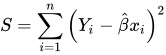
so
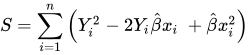
So we do some derivation and you get for minimization the derivative is set to 0:

Divide both sides by -2 and redistribute the summation any will get:

Take beta out and divide by Sum xi2:
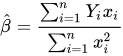
And therefore the least squares estimator for β, is given by

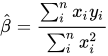
Biasedness[bewerken]
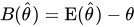

So check if

Let us use this on the estimator in a):
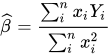
Now let us fill in the proposed population model into this equation:

and you will get:
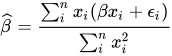
Which is:
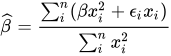
And this can be written as:
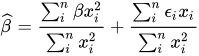
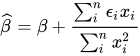
According to biasedness equation above we can take the expectation from both sides according to:
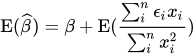
and as

you get:

Therefore unbiasedness applies.
Sigma[bewerken]
First we start with the equation:

rearrange:
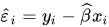
SSR[bewerken]

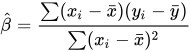


sigma[bewerken]
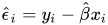

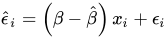
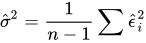
Take the variance of beta-hat:
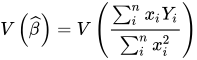
Fill in the estimator of a):
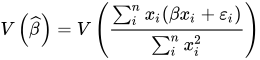
Now use the equation for Yi:
and fill that in the previous equation and you get:
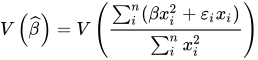
Two typical properties of variance when X and Y are independent are the following:

and

this will be used:
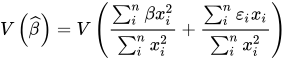
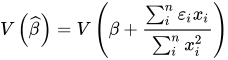

Using the definition given for Variance of epsilon:
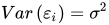
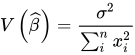
[bewerken]
| |
|
|
|
|
|
Sjabloon[bewerken]
Afbeelding:Crystal Clear action player play.png
| Question 1 |
| Question 2 |
| Question 3 |
| Question 4 |